Couple and Family Map
- rogerlinpsyd
- Dec 17, 2025
- 3 min read
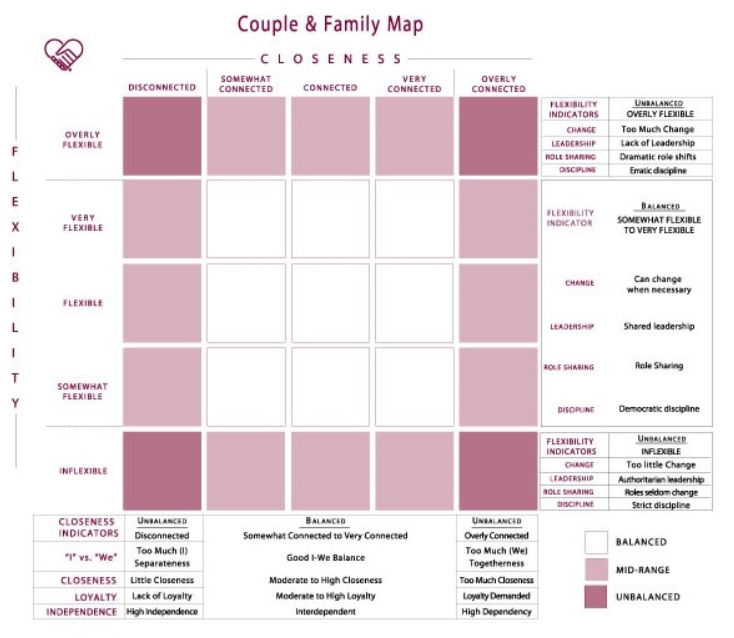
The PREPARE/ENRICH Premarital Couple and Family Map assesses a couple's relational dynamics, particularly focusing on closeness and flexibility, to help them understand their strengths and growth areas.
Key Components:
Closeness: Measures emotional bonding, time spent together, and the degree of interdependence in the relationship. It ranges from disengaged (low connection) to enmeshed (highly connected, possibly overly dependent).
Flexibility: Assesses adaptability in the relationship, including leadership roles, decision-making, and openness to change. It ranges from rigid (inflexible roles) to chaotic (highly unpredictable).
Application:
1. Understanding Closeness in the Relationship
Closeness refers to how emotionally connected partners feel and how much they rely on each other for support. The scale includes:
Disengaged: Partners are emotionally distant, independent, and do not rely on each other much.
Somewhat Connected: Moderate emotional connection, but still maintains strong individual identities.
Connected: A healthy balance of intimacy and independence.
Very Connected: High emotional bonding with shared activities and deep interdependence.
Enmeshed: Extremely close to the point of dependency, possibly lacking personal space.
How to Apply It:
If a couple is too disengaged, they should work on increasing emotional connection by spending more quality time together and expressing appreciation.
If they are too enmeshed, they may need to develop more individual interests and ensure they maintain healthy personal boundaries.
Couples should strive for a balanced closeness, where they feel connected but still maintain their individuality.
2. Understanding Flexibility in the Relationship
Flexibility refers to how well a couple adapts to change, makes decisions, and shares leadership roles. The scale includes:
Rigid: Strict rules, little adaptability, and one partner may dominate decision-making.
Somewhat Flexible: Moderate adaptability but with some structured roles.
Flexible: A good balance between stability and adaptability, with shared decision-making.
Very Flexible: Highly adaptable with frequent role changes.
Chaotic: No clear structure, frequent role changes, and difficulty maintaining stability.
How to Apply It:
If a couple is too rigid, they may need to work on being more open to change, sharing responsibilities, and discussing decisions together.
If a couple is too chaotic, they may need to establish more consistency and clear expectations in their relationship.
A balanced flexibility allows couples to adjust when needed while still maintaining stability.
3. Identifying Strengths and Growth Areas
After assessing their levels of closeness and flexibility, couples can:
Identify what they do well, such as strong emotional support or adaptability.
Recognize areas where they need to improve, like communicating needs or adjusting to life changes.
Work together to find ways to balance their closeness and flexibility for a healthier, long-term relationship.
4. Practical Strategies to Strengthen the Relationship
For Closeness: Plan regular date nights, engage in meaningful conversations, express appreciation, and set aside time for each other.
For Flexibility: Be open to discussing changes, take turns in decision-making, and adjust roles as needed based on circumstances.
For Both: Practice active listening, resolve conflicts constructively, and set relationship goals together.
Exercises for Closeness
1. Love Map Exercise
Each partner writes down five things they believe are important to their partner (e.g., dreams, favorite activities, stressors).
Share your lists and discuss what you got right or missed.
2. Daily Check-In
Set aside 10-15 minutes each day to share something about your day, how you’re feeling, and something you appreciate about your partner.
3. Quality Time
Plan an activity together without distractions (e.g., a walk, cooking, or playing a game).
Reflect: Did this make you feel more connected? How can you do this regularly?
Exercises for Flexibility
1. Role Swap for a Day
Switch responsibilities (e.g., if one usually cooks, the other does it).
Discuss how it felt and what you learned about each other’s roles.
2. Decision-Making Practice
Choose a small decision (like where to go for dinner) and practice collaborative decision-making where both opinions matter.
Reflect: Did one person dominate? Did you both feel heard?
3. “What If” Scenarios
Discuss how you’d handle major life changes (job loss, moving, having kids).
Role-play or brainstorm solutions together to practice adaptability.
Discussion Questions
Closeness:
Do you feel emotionally connected in our relationship? Why or why not?
How do you prefer to receive love and affection? (Words, touch, quality time, etc.)
Are there ways we can improve how we support each other emotionally?
Flexibility:
How do we typically handle change? Are we too rigid or too chaotic?
Are we sharing responsibilities fairly, or does one of us take on too much?
How can we better balance stability with adaptability in our relationship?
Comments